
Economic consequences outlast military conflicts because the damage to productive capacity, institutions, and trust persists long after the fighting stops. When a country enters war, it doesn’t simply wind down production for a few years and resume normal growth—it suffers a structural shock that reduces GDP by more than 30% relative to trend five years after the war’s start, with research on 115 conflicts spanning 75 years showing no evidence of recovery even a decade later. Ukraine exemplifies this dynamic: four years into Russia’s invasion, the country faces a reconstruction bill of $588 billion—nearly three times its projected 2025 GDP—while losing an average of $172 million per day in economic output. This isn’t a temporary disruption.
It’s a permanent reordering of the economy that investors and policymakers must understand. This article examines why economic damage from conflicts proves so stubborn and lasting. We’ll explore the specific mechanisms that keep economies depressed decades after peace agreements are signed, from debt burdens and infrastructure destruction to the collapse of investment and trade. We’ll look at real-world cases—Ukraine, Gaza, and post-WWII recovery—to see how quickly damage accumulates and why some economies recover while others remain scarred for generations. For investors, understanding these dynamics matters because they shape geopolitical risk, sovereign debt markets, and long-term growth trajectories.
Table of Contents
- How Long Do Economic Scars from War Actually Last?
- The Debt Trap—Why Military Spending Creates Long-Term Economic Burdens
- Infrastructure Destruction and Supply-Side Spillovers
- Case Studies—Ukraine, Gaza, and the Speed of Economic Deterioration
- Why Recovery Fails—The Persistent Inflation and Investment Collapse
- When Conflicts Do Recover—The Marshall Plan Exception
- For Investors—What This Means for Geopolitical Risk and Markets
- Conclusion
How Long Do Economic Scars from War Actually Last?
The research is unambiguous: war leaves deep, persistent scars that defy typical economic recovery patterns. A study by economists examining data across 145 countries over 75 years found that on average, GDP in war sites is reduced by more than 30% relative to trend five years after a war’s start. But here’s what makes this finding critical: there is no evident recovery even a decade later. In only 29% of cases does GDP per capita return to trend levels within five years; in almost half of all cases, income remains below trend 25 years or more after the conflict ends. This isn’t like a recession or financial crisis, where central banks can cut rates and stimulus eventually reignites growth.
War breaks something deeper. The persistence varies by conflict type. Civil wars create more long-lasting economic impacts than wars between nations, likely because they destroy not just physical infrastructure but the social bonds and institutions that make an economy function. Interstate wars damage exports, trade routes, and supply chains—severe problems, but potentially fixable. Civil wars atomize trust, displace populations permanently, and can undermine governance for decades. Ukraine and Gaza illustrate both patterns: Ukraine as an interstate conflict destroying physical assets and energy infrastructure; Gaza as a protracted occupation with 80% unemployment, reflecting institutional and social collapse alongside physical devastation.
The Debt Trap—Why Military Spending Creates Long-Term Economic Burdens
Governments finance wars through borrowing, and that debt becomes the economic anchor around the country’s neck for decades. military spending incurs obligations that extend far beyond the conflict itself: interest payments on war bonds, pensions and medical care for veterans, and the ongoing cost of military readiness. Research shows that military spending creates a GDP multiplier usually less than 1, meaning a dollar spent on defense produces less than a dollar of economic growth—unlike, say, spending on education or infrastructure, which can produce multipliers above 1. When a government borrows heavily to wage war, it’s essentially trading short-term military capability for long-term poverty. The scale is staggering. global military spending hit $2.4 trillion in 2024, concentrated in the U.S., China, and Europe.
But this doesn’t tell the full story. Violence and conflict more broadly—including indirect costs like reduced investment, lower productivity, and health impacts—cost the world economy approximately $19.1 trillion in 2024, representing 13.5% of entire world GDP. That’s roughly equivalent to the combined GDP of the U.S. and EU. For a country engaged in active conflict, the burden is even heavier: they must fund the war while simultaneously losing tax revenue as the economy contracts. Russia, for instance, lost $40 billion annually in gas export revenue due to EU sanctions, tightening the fiscal vise. The debt burden compounds generationally.
Infrastructure Destruction and Supply-Side Spillovers
Wars destroy the physical scaffolding that economies depend on—roads, ports, power plants, housing—and rebuilding isn’t merely a matter of construction spending. Destruction of housing, transport, and energy infrastructure creates what economists call “supply-side spillovers” that persist long after the physical rebuilding is complete. When 14% of all housing stock is damaged or destroyed, as in Ukraine, you don’t just have a housing shortage; you have millions of displaced people, reduced labor supply in key regions, abandoned businesses, and an entire generation of savings wiped out. Energy infrastructure damage is even more insidious: Ukraine’s damaged or destroyed energy assets increased by 21% in the past year, forcing the country to import power at premium prices and limiting industrial production.
However, the severity and recovery speed depend heavily on the type of infrastructure destroyed and whether supply chains can be rerouted. A highway can be rebuilt in months; a generation of human capital lost to displacement takes decades to replace. A port can be repaired; the trust of international investors that made it profitable must be rebuilt from scratch. Gaza’s experience illustrates the worst case: with 70% of GDP fallen to the 2022 level and unemployment at 80%, the infrastructure destruction is so severe that even reconstruction spending wouldn’t immediately restore growth—the institutions and investor confidence to absorb that spending simply don’t exist.
Case Studies—Ukraine, Gaza, and the Speed of Economic Deterioration
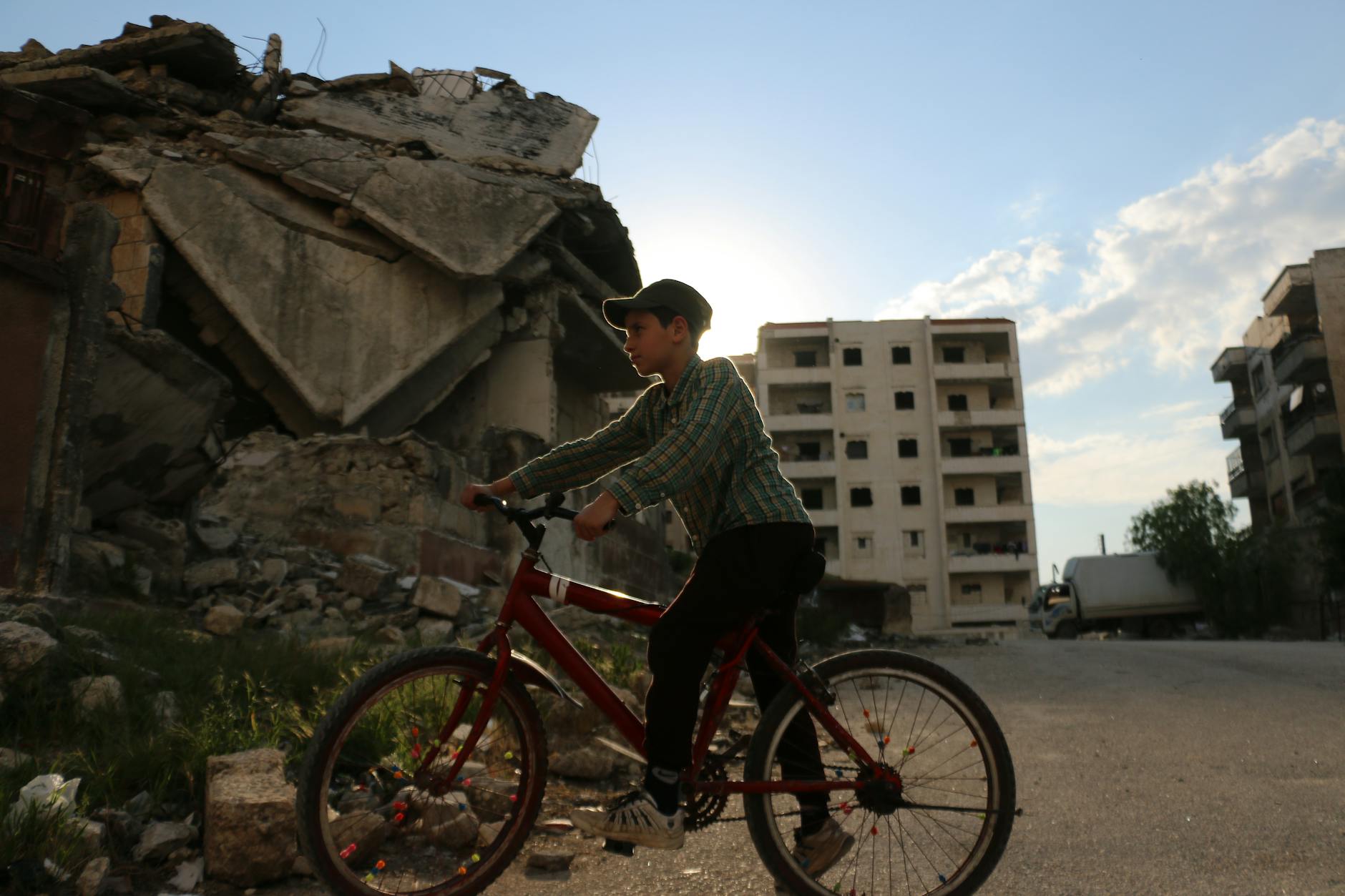
Ukraine’s war provides the clearest current example of how rapidly economies spiral downward. After four years of conflict, Ukraine faces $588 billion in reconstruction needs—nearly triple its projected 2025 GDP. Direct physical damage has surpassed $195 billion. But the daily cost is what’s most telling: Ukraine loses an average of $172 million per day in economic output, a figure that has accelerated from 2024 levels as Russian strikes intensify against energy and civilian infrastructure. Housing destruction alone—14% of all housing damaged or destroyed—has displaced over 3 million households, fragmenting the labor market and destroying wealth.
Gaza presents a different catastrophe: collapse rather than active reconstruction. Gaza’s GDP fell to 70% of its 2022 level, erasing 22 years of economic progress in four years. Unemployment surged to 80%, implying that economic activity has essentially ceased for most of the population. Palestinian reconstruction needs are estimated at $70 billion—more than 6 times Palestinian GDP in 2024—a gap so wide that it signals decades of dependency on external aid or indefinite poverty. The contrast is instructive: Ukraine has infrastructure to rebuild and an international coalition offering assistance (though far below the need); Gaza has neither. Recovery trajectories will diverge dramatically, but both illustrate how quickly war erases decades of development.
Why Recovery Fails—The Persistent Inflation and Investment Collapse
When a war erupts, inflation spikes immediately. Research shows that war sites experience a 15 percentage point increase in inflation during the first year following the war’s start. But here’s the critical failure point: inflation remains high afterwards. This is not a temporary shock. Governments attempt to finance wars through money printing, destroying currency value; supply shocks from infrastructure destruction and labor displacement push prices higher; and investor flight from the country’s assets and debt drives currency depreciation further. Combined, these forces create persistent high inflation that compounds the real economic damage.
Investment collapses during and after wars, and this collapse is what really locks in long-term stagnation. Investors flee conflict zones not just during the fighting but remain skeptical for years afterward. Foreign direct investment dries up. Domestic entrepreneurs can’t secure credit. The return to positive real interest rates—necessary to eventually restore investment—requires sustained price stability, which war-torn economies struggle to achieve. This is why recovery is so slow: the economy can’t reignite growth without investment, but investment won’t return until inflation is tamed, and inflation won’t be tamed until government spending is controlled—impossible while reconstruction demands remain enormous.

When Conflicts Do Recover—The Marshall Plan Exception
Recovery is possible, but it requires extraordinary intervention. The Marshall Plan, the U.S.-funded reconstruction of Western Europe after WWII, achieved remarkable results: recipient countries recovered production in 3 years and exports in 4 years post-war, with GDP growth of 35% and intra-European trade increasing by 80%. This success wasn’t accidental.
It required: massive external funding (roughly $140 billion in today’s dollars), a commitment to restoring democratic institutions, a deliberate focus on trade integration, and, critically, war duration that had been relatively short (by modern standards) and followed by clear geopolitical anchoring in the Western alliance. Research on recovery patterns reveals the factors that enable faster healing: strong pre-war GDP growth (wealthy countries recover faster than poor ones), quality democratic institutions (countries with rule of law recover faster), shorter war duration (obvious but important), smaller wartime GDP drops, and absence of return to hostilities. Ukraine potentially meets some criteria—it has pre-war democratic institutions and external support—but falls short on others: the war duration is already longer than WWII for most participants, the GDP drop has been catastrophic, and the risk of renewed hostilities remains high. Most modern conflicts fail to achieve Marshall Plan conditions, which is why they remain economically depressed for 20+ years.
For Investors—What This Means for Geopolitical Risk and Markets
The persistence of economic damage from military conflicts reshapes geopolitical risk for investors in fundamental ways. It means that wars aren’t brief interruptions to normal business; they’re structural breaks that alter emerging market growth trajectories, sovereign debt sustainability, and asset valuations for decades. A country engaged in active conflict or recently emerged from one is not a “buy the dip” opportunity—it’s a systemic risk. Investors in Ukrainian assets face not a 2-3 year recovery window but a 15+ year process of rebuilding with uncertain outcomes.
This also shapes thinking about conflict escalation risk. Small conflicts that investors dismiss as “priced in” or “geopolitical noise” can metastasize into long-term structural drags. The $19.1 trillion annual cost of global violence (2024) represents capital that could otherwise fund innovation, education, and productive investment. For equity investors, this suggests tilting toward stable geographies and away from regions with elevated conflict risk—not for short-term tactical reasons, but because the long-term growth math is fundamentally different. For sovereign debt investors, it means treating conflict-adjacent bonds with extreme skepticism unless yields compensate for a 15+ year recovery horizon and substantial default risk.
Conclusion
Economic consequences outlast military conflicts because wars inflict structural damage—to institutions, infrastructure, investor confidence, and human capital—that takes decades to repair, if ever. The research is unambiguous: GDP contractions of 30%+, persistent inflation, investment collapse, and debt burdens combine to lock war-torn economies into low-growth equilibria long after the shooting stops. Ukraine’s $588 billion reconstruction need, Gaza’s 80% unemployment, and historical data spanning 75 years of conflicts all point to the same conclusion: wars are not temporary disruptions to be weathered and forgotten, but permanent scarring events.
For investors, this insight has practical weight. It argues for avoiding conflict zones as growth opportunities, skepticism toward claims that post-conflict recoveries will be quick, and recognition that geopolitical risk operates on a decades-long timescale, not quarterly earnings cycles. The Marshal Plan remains the exception that proves the rule—large-scale recovery requires extraordinary external support, institutional quality, and favorable conditions that most modern conflicts lack. Until those conditions emerge, economies emerging from war remain fundamentally altered, with implications for returns and risk that extend well beyond the headlines.