
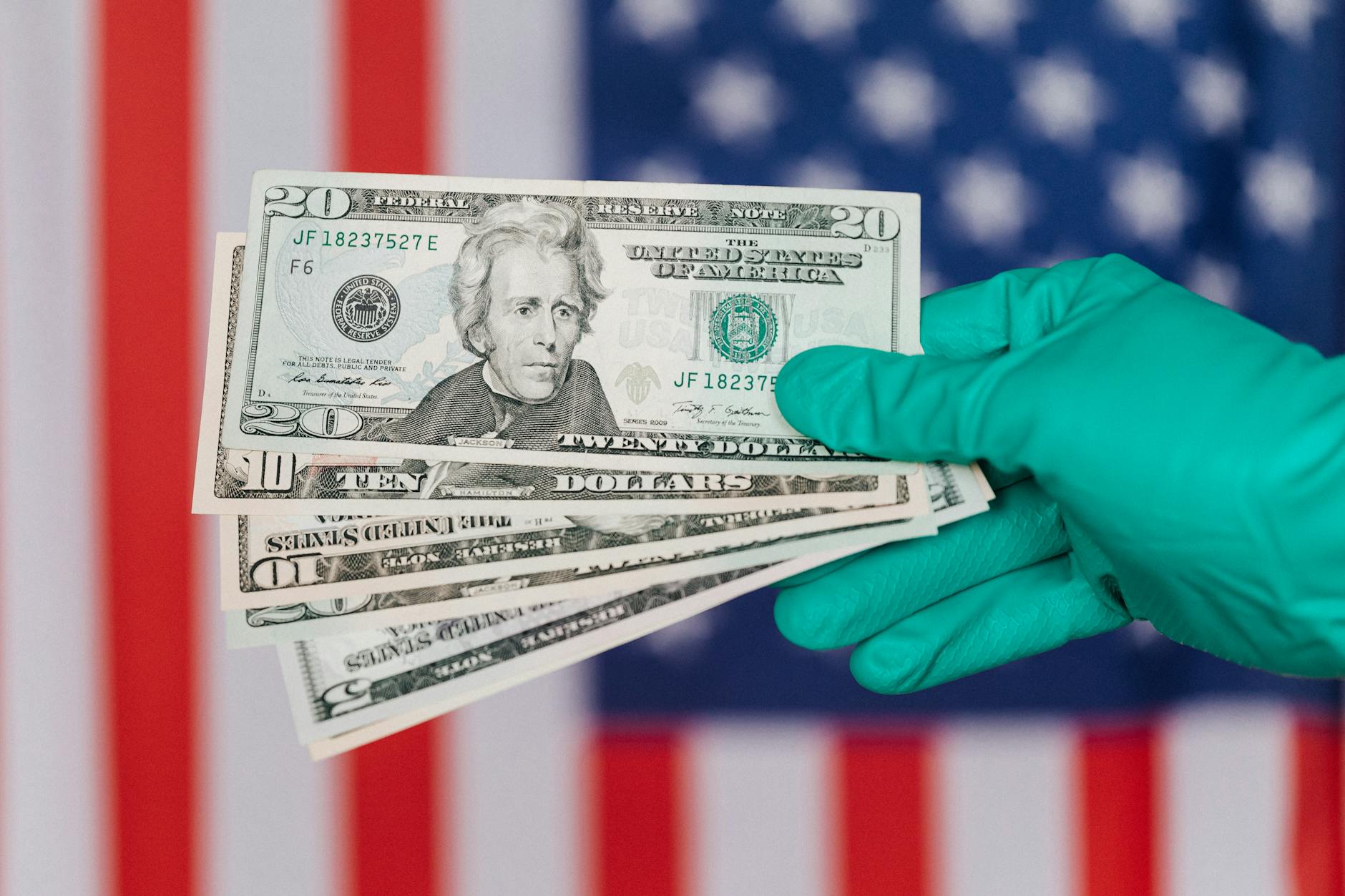
No, there is no $2,210 stimulus check being deposited into American bank accounts right now. The claim, which has spread rapidly across social media and through viral videos, has been rated FALSE by PolitiFact. The links embedded in these posts do not lead to any government website. They redirect to a Las Vegas-based insurance agency site designed to harvest your personal information — a textbook lead-generation scam.
The IRS has not announced any new stimulus payment program, and Congress has not authorized a single dollar in new direct payments to individuals in 2026. If you logged into your bank account this month and saw a large deposit from the federal government, it is almost certainly your regular tax refund, not a stimulus check. The average federal tax refund can exceed $2,000 thanks to standard withholdings and credits like the Child Tax Credit, which leads many people to confuse routine refunds with some kind of new government payout. Scammers exploit exactly this kind of confusion, timing their viral posts to coincide with peak tax refund season in February and March. This article breaks down where the $2,210 claim actually came from, why Trump’s proposed “tariff dividend” is not happening, what the real legislative landscape looks like, and how to protect yourself from stimulus scams that are growing more sophisticated by the month.
Table of Contents
- Is a $2,210 Stimulus Check Real, and Is the Government Depositing Payments Right Now?
- What Happened to Trump’s $2,000 Tariff Dividend Proposal?
- The Bills That Actually Exist — and Why They Have Not Moved
- How to Tell the Difference Between a Tax Refund and a Stimulus Check
- How Stimulus Scams Are Getting More Sophisticated in 2026
- State-Level Payments That Scammers Exploit for Confusion
- What Investors Should Actually Watch For
- Conclusion
- Frequently Asked Questions
Is a $2,210 Stimulus Check Real, and Is the Government Depositing Payments Right Now?
It is not real. The federal government has issued exactly three rounds of stimulus checks in its history — all during 2020 and 2021 under COVID-19 emergency relief legislation. The first round sent $1,200 per adult, the second sent $600, and the third sent $1,400. There has been no fourth stimulus check authorized by Congress, and no legislation creating a $2,210 payment has been introduced, debated, or signed into law.
The number itself appears to have been fabricated to sound plausible enough to generate clicks. The scam works by exploiting the gap between what people hope is true and what they are willing to verify. A post claims a specific dollar amount — $2,210 in this case — and tells people to click a link to “check eligibility.” That link routes through several redirects before landing on a private commercial website that asks for your name, address, phone number, and sometimes your Social Security number. You never receive money. The people running the site receive your data, which they sell to insurance brokers, telemarketers, or worse. It is worth emphasizing that the IRS does not contact people via email, text message, or social media about payments. Any legitimate government resource will live on a .gov or .mil domain.
What Happened to Trump’s $2,000 Tariff Dividend Proposal?
President Trump floated the idea of a $2,000 “tariff dividend” that would redistribute tariff revenue directly to American households. The concept drew significant attention, but it remains a proposal only. It is not law. No executive order has been signed to create it. No legislation enacting it has passed either chamber of Congress. As of mid-March 2026, the proposal exists in the same category as a campaign promise — something discussed publicly but not acted upon through the legislative process. The odds of it happening have collapsed.
Mark Zandi, chief economist at Moody’s, told CNBC in late February 2026 that the chances are “now effectively zero,” explaining: “This would require legislation, and I don’t see Congress passing it.” The Supreme Court complicated matters further when it ruled against Trump’s tariff authority on February 20, 2026, undermining the legal foundation that any tariff-based dividend would depend on. However, if Congress were to pass new legislation specifically authorizing tariff revenue redistribution — an enormous political lift — the situation could theoretically change. But no serious observer of Capitol Hill expects that to happen in the current session. Scam operators have seized on the tariff dividend discussion with particular enthusiasm. A group calling itself “Major Gross Profit” has circulated emails claiming “Trump’s $2,000 tariff dividend is live but you must act,” according to a WRAL fact check. The emails are fraudulent. There is no dividend to claim, live or otherwise.
The Bills That Actually Exist — and Why They Have Not Moved
Two competing pieces of legislation have been introduced that relate to tariff-based payments, but neither has advanced beyond its initial committee referral. Understanding their status helps illustrate just how far away any real payment is from reaching your bank account. Senator Martin Heinrich, a Democrat from New Mexico, introduced the Tariff Refunds for Working Families Act. It would provide joint filers earning under $180,000 a $1,200 rebate, plus $600 per dependent child. The bill was referred to the Senate Finance Committee, where it has sat without a hearing or markup. On the House side, Representative Tim Burchett, a Republican from Tennessee, introduced the Trump Tariff Rebate Act, which takes a different approach entirely — rather than direct payments, it would increase the standard deduction on federal income taxes.
That bill was referred to the House Ways and Means Committee and has similarly shown no signs of movement. The key difference between these proposals and an actual payment is enormous. A bill being introduced means a single member of Congress filed paperwork. It does not mean the bill has support, funding, a timeline, or any realistic path to becoming law. Thousands of bills are introduced every congressional session. The vast majority never receive a vote. Until a bill clears committee, passes both chambers, and is signed by the president, it is not law and no money flows from it.
How to Tell the Difference Between a Tax Refund and a Stimulus Check
If you received a deposit from the IRS in March 2026, check your IRS account transcript or the “Where’s My Refund” tool at irs.gov. A tax refund will show as a credit associated with your filed return for tax year 2025. It reflects money you overpaid in federal taxes throughout the year, now being returned to you. A stimulus check, by contrast, would appear as an Economic Impact Payment — a term the IRS used for all three prior rounds — and would not be tied to a filed return. The practical distinction matters because a tax refund is your own money coming back to you. It is not a bonus, a windfall, or a government handout.
If your refund is around $2,000, that may feel like a stimulus payment, especially if social media has been telling you to expect one. But the math is straightforward: if you had federal taxes withheld from your paychecks and your actual tax liability was lower than what was withheld, the difference comes back as a refund. The Child Tax Credit alone can add up to $2,000 per qualifying child, which is why many families see refunds in the range that scammers exploit. The tradeoff worth considering is whether a large refund actually serves your financial interests. A $2,000 refund means you gave the government a $2,000 interest-free loan for the year. Adjusting your W-4 withholding to reduce your refund and increase your take-home pay throughout the year can be a smarter move — especially in an environment where high-yield savings accounts and money market funds still offer meaningful returns.
How Stimulus Scams Are Getting More Sophisticated in 2026
The scams circulating in 2026 are markedly more polished than the crude phishing attempts of prior years. They use specific dollar amounts, reference real policy proposals like the tariff dividend, and time their campaigns to coincide with tax season when people are already expecting deposits. Some use deepfake video of public figures or AI-generated news anchors to add a veneer of credibility. The Michigan Department of Consumer Protection has issued a specific warning about federal stimulus payment scams, noting that they often mimic the visual style of government communications. One critical warning: if any website, email, or social media post asks you to provide your Social Security number, bank account details, or a “processing fee” to claim a government payment, it is a scam. No exception.
The IRS already has your banking information if you have received a prior refund via direct deposit. The government does not charge fees to distribute payments, and it does not solicit personal information through unofficial channels. The limitation of even well-intentioned fact-checking is speed. A viral scam post can reach millions of people within hours. Fact-check articles take days to research, publish, and index in search results. By the time a debunking circulates widely, the scammers have already moved on to the next claim — perhaps $2,500, perhaps $3,000, always a different number, always the same scheme.

State-Level Payments That Scammers Exploit for Confusion
Some states do issue direct payments to residents, and scammers deliberately blur the line between these programs and nonexistent federal stimulus checks. Alaska’s Permanent Fund Dividend, which distributes oil revenue to state residents annually, is the most well-known example. In 2025, eligible Alaskans received over $1,600. Other states have run one-time rebate programs tied to budget surpluses.
These are real, legitimate programs — but they are state-specific, funded by state revenue, and have nothing to do with federal stimulus legislation. If you see a claim about a payment and cannot determine whether it is real, go directly to your state government’s official website or to irs.gov. Do not click links in social media posts, forwarded emails, or text messages. Navigate to official sources independently.
What Investors Should Actually Watch For
For investors monitoring the policy landscape, the real story is not about stimulus checks — it is about tariff policy, consumer spending, and the downstream effects on corporate earnings. The Supreme Court’s February 2026 ruling against Trump’s tariff authority has significant implications for trade policy, supply chain costs, and the inflation outlook. Whether Congress revisits tariff legislation, and in what form, will matter far more to your portfolio than any hypothetical direct payment.
The broader pattern worth tracking is how economic anxiety — fueled by tariff uncertainty, persistent inflation in certain categories, and election-year politics — creates fertile ground for financial scams. When people feel squeezed, they are more susceptible to claims about free money. The best defense is not just skepticism but financial literacy: understanding where your money comes from, what your government actually owes you, and how to verify claims before acting on them.
Conclusion
There is no $2,210 stimulus check. There is no $2,000 tariff dividend being deposited. The viral claims circulating on social media are scams designed to steal your personal information. The only federal payments arriving in bank accounts right now are standard tax refunds for the 2025 tax year, which are processed through the normal IRS filing system.
Two tariff-related bills have been introduced in Congress, but neither has advanced, and expert consensus puts the odds of any tariff dividend at effectively zero. Protect yourself by verifying any payment claims through official channels — irs.gov for federal payments, your state government’s website for state programs. Never click links in unsolicited messages claiming you are owed money. If something sounds too good to be true during tax season, it almost certainly is. For investors, the more productive focus is on the actual policy shifts in tariff and trade law that will shape the economic landscape for the rest of 2026 and beyond.
Frequently Asked Questions
Did the IRS announce a $2,210 stimulus payment for 2026?
No. The IRS has not announced any stimulus payment for 2026. The $2,210 figure comes from viral social media scams that PolitiFact has rated FALSE. The only payments the IRS is currently distributing are standard tax refunds for the 2025 filing year.
What is the Trump tariff dividend, and will I receive a $2,000 check?
The tariff dividend was a proposal by President Trump to redistribute tariff revenue to American households as $2,000 payments. It remains only a proposal — not law. Moody’s chief economist Mark Zandi has said the odds of it passing Congress are “effectively zero,” and the Supreme Court’s February 2026 ruling against Trump’s tariff authority further diminished its prospects.
Why did I receive a large deposit from the IRS this month?
If you filed your 2025 federal tax return and received a direct deposit from the IRS in early 2026, that is your tax refund — money you overpaid in taxes during the year being returned to you. It is not a stimulus check. You can verify this using the IRS “Where’s My Refund” tool at irs.gov.
How can I tell if a stimulus check claim is a scam?
If a social media post, email, or text message asks you to click a link to “check eligibility” for a government payment, it is almost certainly a scam. The IRS does not contact people through social media, email, or text about payments. Legitimate government websites use .gov or .mil domains. Never provide your Social Security number or bank details through unofficial channels.
Are any states sending stimulus-like payments in 2026?
Some states run their own payment programs unrelated to federal stimulus. Alaska distributes its Permanent Fund Dividend annually, and other states occasionally issue rebates tied to budget surpluses. Check your state government’s official website for any programs you may be eligible for. Do not rely on social media claims that conflate state programs with nonexistent federal payments.
You Might Also Like
- Fact Check: Is a $3,790 Stimulus Check Being Deposited Nationwide? No. Here’s What’s Real and What’s a Scam.
- Fact Check: Is a $2,735 Child Tax Deposit Being Mailed in March 2026? No. Here’s What You Need to Know.
- Fact Check: Are Food Stamp Recipients Being Sent a $3,175 Property Tax Refund in May? No. Here’s What You Should Know.